IJAPS logo International Journal of Applied Pharmaceutical SciencesISSN 2394-7446 (Online) · Peer-reviewed · Open access
✓ Call for Papers · Special Issue

Artificial Intelligence in Drug Discovery, Development and Regulatory Science

Special issue of IJAPS · Manuscripts due 31 March 2027

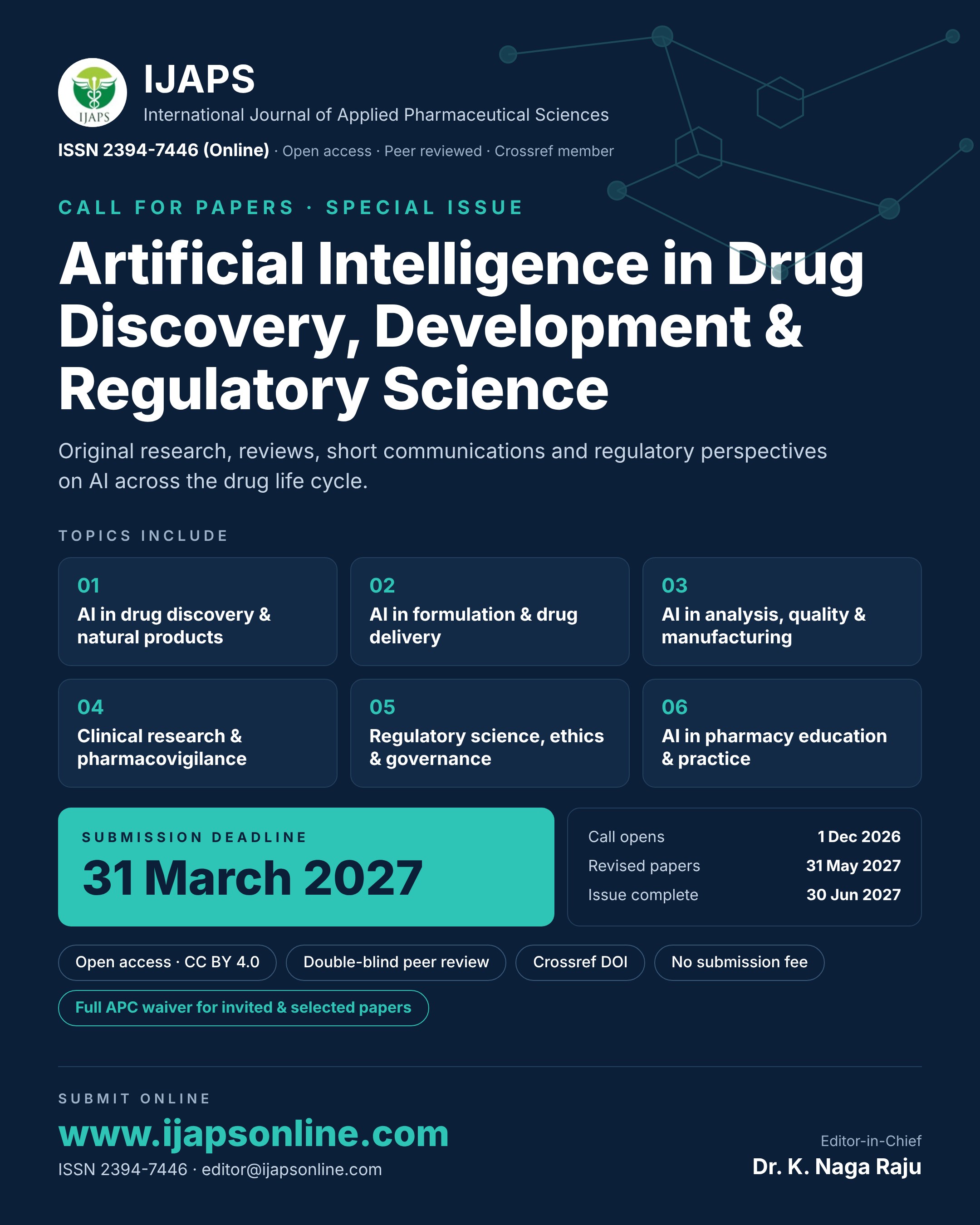
IJAPS special issue call for papers poster

Download the poster (JPG) · share it with colleagues and students

At a Glance

JournalInternational Journal of Applied Pharmaceutical Sciences (IJAPS), ISSN 2394-7446 (Online)
Special issueArtificial Intelligence in Drug Discovery, Development and Regulatory Science
Access and licenceOpen access · CC BY 4.0 · authors keep copyright
Peer reviewDouble-blind, at least two independent reviewers
DOICrossref DOI for every published article
SubmissionOnline at journal.ijapsonline.com
Manuscript deadline31 March 2027

About the Special Issue

Artificial intelligence (AI) is now used at every stage of the drug life cycle, and regulators are writing the rules for it. Machine learning supports target identification, molecular design, formulation optimisation, process control, clinical trial design and safety surveillance. The question has shifted from whether AI can help to whether its outputs are credible enough to support decisions on safety, efficacy and quality.

Regulators have started to answer that question:

  • US FDA issued its first draft guidance on the use of AI to support regulatory decision-making for drugs and biological products in January 2025, built around a risk-based credibility assessment for the model’s context of use.
  • FDA and EMA jointly published guiding principles of good AI practice in drug development in January 2026.
  • EMA published a reflection paper on the use of AI in the medicinal product life cycle in 2024.
  • India: the ICMR Ethical Guidelines for Application of Artificial Intelligence in Biomedical Research and Healthcare (2023) frame responsible use for Indian researchers, while CDSCO’s approach continues to evolve.

Much of the published work is still computational proof-of-concept with little external validation. IJAPS especially welcomes studies that validate AI models against experimental or clinical data, compare them with conventional methods, or examine their regulatory and ethical readiness, including in low- and middle-income settings.

Topics of Interest

Submissions may address, but are not limited to, the six tracks below.

1AI in drug discovery
  • Target identification and validation using multi-omics data
  • Generative models and de novo molecular design
  • AI-assisted virtual screening, docking and molecular dynamics
  • Drug repurposing, including for neglected and tropical diseases
  • AI for natural products, phytochemicals and traditional medicine (network pharmacology, compound–target prediction)
2AI in pharmaceutics and formulation development
  • ADMET, solubility and stability prediction
  • Machine-learning-guided formulation and excipient selection within Quality by Design
  • AI for nanocarriers and novel drug delivery systems
  • 3D printing and personalised dosage forms
3AI in pharmaceutical analysis, quality and manufacturing
  • Chemometrics and AI for chromatographic and spectroscopic method development
  • AI-enabled Process Analytical Technology, continuous manufacturing and digital twins
  • Predictive quality, deviation and CAPA analytics, and data integrity (ALCOA+)
  • Computerised system validation for AI tools in GMP settings
4AI in clinical research, pharmacology and pharmacovigilance
  • Trial design, patient recruitment and synthetic control arms
  • Model-informed drug development, PK/PD and precision dosing
  • Adverse event signal detection from spontaneous reports, EHRs and social media
  • Pharmacogenomics and AI-driven precision medicine
5Regulatory science, ethics and governance of AI
  • Model credibility, context of use and risk-based assessment
  • Comparative analysis of FDA, EMA, CDSCO, MHRA, PMDA and WHO approaches
  • AI in regulatory writing, eCTD dossiers and regulatory intelligence
  • AI as software as a medical device (SaMD) and its regulation in India
  • Bias, transparency, explainability, data privacy (DPDP Act 2023) and accountability
6AI in pharmacy education and practice
  • AI tools in pharmacy curricula and assessment
  • Clinical decision support and AI in community and hospital pharmacy
  • Large language models in pharmaceutical sciences: uses, limits and validation

Article Types

Article typeWhat we look for
Original researchAI models validated against experimental, analytical or clinical data
Review / systematic review / meta-analysisCritical synthesis with a clear method (PRISMA 2020 for systematic reviews)
Short communicationNew tools, datasets or preliminary validated findings
Regulatory perspective / commentaryAnalysis of guidance, policy gaps or comparative frameworks
Case study / tool reportReal-world use in industry, hospital, laboratory or classroom

Length and format follow the IJAPS author guidelines.

Requirements for AI-based Studies

  • State the model, training data, validation method and performance metrics.
  • Follow the relevant reporting guideline: TRIPOD+AI (prediction models), CONSORT-AI or SPIRIT-AI (trials and protocols), DECIDE-AI (early clinical evaluation).
  • Include a data and code availability statement. Sharing via GitHub, Zenodo or similar is strongly encouraged.
  • Disclose any use of generative AI in writing the manuscript. AI tools cannot be listed as authors.

Important Dates

MilestoneDate
Call opens1 December 2026
Optional abstract / intent to submit31 January 2027
Full manuscript deadline31 March 2027
First review decisionWithin 4–6 weeks of submission
Final revised manuscripts31 May 2027
Special issue complete30 June 2027

Accepted articles receive their DOI and are published online as soon as they are ready (continuous publication), then grouped in the special issue.

How to Submit

  1. Prepare the manuscript following the IJAPS author guidelines.
  2. Submit online and choose the section “Special Issue: AI in Drug Discovery, Development and Regulatory Science”.
  3. Upload an anonymised manuscript and a separate title page (author names, affiliations, ORCID iDs) for double-blind review.
  4. Add a cover letter naming the track (1–6) your paper fits.
  5. Include declarations: conflicts of interest, funding, ethics approval where relevant, data and code availability, and use of generative AI.

Submit to the Special Issue →

Article Processing Charge

Author categoryAPC (charged only after acceptance)
Indian authors₹5,000
International authorsUS$150
Invited papers and selected high-quality submissionsFull waiver
Authors from low-income countries; students as first authorWaiver or discount on request

There is no submission fee. Payment or waiver status has no influence on editorial decisions.

Publication Policy

  • Open access under CC BY 4.0; authors keep copyright.
  • Double-blind peer review by at least two independent reviewers.
  • Every submission is screened for similarity before review.
  • Each published article receives a Crossref DOI.
  • IJAPS follows COPE guidance on publication ethics.

Contact

Questions about scope, waivers or pre-submission enquiries: Dr. K. Naga Raju, Editor-in-Chief · editor@ijapsonline.com

Journal Details

ISSN (Online):
2394-7446
Frequency:
Bimonthly (quarterly from 2027)
Access:
Open Access
Licence:
CC BY 4.0
APC:
₹5,000 / US$150 after acceptance
Review:
Double-blind
Language:
English
Publisher: Dr. K. Naga Raju, Pedaparimi Post, Thullur Mandal, Guntur District, Andhra Pradesh – 522236, India